
A Luminous Halo

"Life is not a series of gig lamps symmetrically arranged; life is a luminous halo, a semi-transparent envelope surrounding us from the beginning of consciousness to the end." --Virginia Woolf

My Photo
Name:
Location: Springfield, Massachusetts, United States

Smith ’69, Purdue ’75. Anarchist; agnostic. Writer. Steward of the Pascal Emory house, an 1871 Second-Empire Victorian; of Sylvie, a 1974 Mercedes-Benz 450SL; and of Taz, a purebred Cockador who sets the standard for her breed. Happy enough for the present in Massachusetts, but always looking East.

Wednesday, April 23, 2014

Maggie Rose Redux

In 1960, I kept a diary. I was 12 years old. In 2011, I posted in this blog each day the text of my diary entry for that same day in 1960. Many things I remembered, but a surprising number of entries seemed to have been written by another person. In many instances I had no recollection whatsoever of the events described, and I was taken aback by some of my reactions. Overall I had the feeling, copying out those old entries, that a messy, disorganized, slightly mercenary preteen had usurped the place of the saintly little Cicily of my memories. The diary Cicily had terrible taste in movies, didn't always finish her homework, and was occasionally mean to her friends. Part of me wanted to burn the evidence, but being a journalist and a historian, I opted to publish it here.

On April 9, 1960 I wrote:
 "At Steiger's there was a fountain, so we threw in pennies (my pennies). I finished 'Maggie Rose,' it was wonderful."
I have no recollection of having read Maggie Rose. But I was curious about what my younger self--the self I am realizing I don't actually know all that well--would have considered "wonderful." The Springfield library system no longer owns a copy of the book, but the Berkshire Athaneum does, and through the miracle of the inter-library loan, that copy arrived at my local branch a few days ago and I was able to re-read it.

Maggie Rose is written by Newbury medalist Ruth Sawyer, a storyteller, teacher, reporter and author who lived in Boston. (Sawyer's son-in-law was Robert McCloskey, author of Make Way for Ducklings.) It's illustrated by none other than Maurice Sendak. The story takes place in 1951. Maggie Rose is an enterprising little girl, the rest of whose family is cheerfully indolent. On June 24 she realizes her birthday, which falls on Christmas Eve, is exactly half a year away. She makes plans to have, for the first time, a real birthday/Christmas celebration (her family is too lazy and too poor ever to have gone to that much effort). For six months she works to earn money and make preparations. The story ends on December 24 with her party, a smashing success.

Maggie Rose actually is a pretty good book. I think what I like about it--and what my twelve-year-old self probably liked--is the sense of place evoked in the story. Maggie Rose lives in a small Maine seacoast town. She spends a lot of time outdoors in her "secret place" on the fringe of the woods. Flora and fauna are lovingly described by Sawyer...hemlocks and pine, spruce and birch, mosses, rocks, sparrows. The other nice thing about the book is Maggie Rose herself. She's a reader, a dreamer, and a resourceful child. Kind of like me as a girl. Or at least what I think I was like.

Labels: , , , , ,

Sunday, February 09, 2014

Amy Lowell

Biography is not my favorite genre, but nevertheless two particular biographies have endeared themselves to me. One is a two-volume work by Eve Curie about her mother, Marie, and the other is S. Foster Damon's 1935 Amy Lowell. I read these in junior high school for book reports. The former is two thick volumes, translated from the French, and the latter a hefty 773 pages. Spend that much time learning about someone's life and you are bound to come away with an appreciation.

The books were not my own; they were checked out of the Forest Park branch of the public library. That branch was right across the street from my junior high school, and probably the place I spent the most time in my childhood, after home and school. At least until I went to high school--at that point it was probably home, school, and the downtown branch of the library. That main branch was across the street from my high school.

 One of the perks of my current location is its proximity to the downtown branch of that same library. If anyone had told me in the 1950s or 1960s that I would go away to college, live on three different continents, and end up two blocks from my old high school and library, I would have had difficulty believing it. But that's what happened. And anyone who knows this blog knows my appreciation for the free shelf in that downtown library.

So imagine my pleasure a while back at finding a copy of Amy Lowell's biography on said free shelf. My pleasure turned to amazement when I realized it was the self-same copy I had checked out probably in 1961, discarded by the Forest Park branch. Now it's a treasured addition to my own library. As the King of France says to King Lear, "Be it lawful I take up what's cast away."

Today is the 140th birthday of Amy Lowell, Massachusetts socialite and poetess, critic and translator, friend and rival of Ezra Pound, cigar-smoking antifeminist beloved of current feminists. She was born in Brookline, buried in Cambridge. I think I'll celebrate her birthday tonight by re-reading her biography.

Labels: , , , ,

Saturday, March 24, 2012

GGGG


Today was the third annual Author Fair at the Springfield Central Library. I LOVE walking a block or two to a nice event that doesn't cost anything....it's one of the perks of living downtown. (I've only filled my gas tank once since September!) So over I went.

The beautiful library rotunda was filled with tables, behind which sat local authors with copies of their books, their business cards, and whatever other items they wanted to display. Randy Purinton had articles and research materials pertinent to his Civil-War-era non-fiction book, It Hasteth Away, Husein Muhammad had rocks painted to look like the ones in his children's book The Man, Blanche Jackson-Hill had lollipops and Monopoly money for Straight to the Point Financing, Gerry Garner had beautiful bonsai.

Ms. Garner--GGGG, she calls herself, for Great-Grandmother Gerry Garner--was so vivacious and interesting, I talked to her for over half an hour. Her book, Generations Build the Future: Positives Needed Now! is a collection of life lessons from people across the age spectrum. (I feel I'm not doing the book justice by my description, but I've yet to read it!)

Gerry Garner recently started a group for authors, and I intend to join it. I'm hoping some of her energy will rub off on me. She's trim, petite, old enough to be a great-grandmother, but incredibly vigorous. She really packs a lot in a small package. Come to think of it, kind of like her bonsai.

Labels: , , , , ,

Monday, February 11, 2008

Freedom Summer

A writer's first job is to observe, then to make connections. Then to work, work, work, researching, writing, revising, over and over until the result looks like a simple, elegant, seemingly effortless production. As though it couldn't have been written any other way. This holds for poets, novelists, diarists, biographers, and yes, even journalists. I'm a journalist myself, and nobody but me knows what goes into even the most superficial piece of fluff I write.

Tonight I walked over to the library for an interesting presentation. Editor James Kates, whom I'd met on Saturday at the publishing panel, was going to be talking about a book his Zephyr Press had just published, Letters From Mississippi. I wasn't sure why a press which specialized in translations would have that on their booklist, but I was excited about the topic, so I went.

Turns out that Kates and the small group he brought along with him had all been participants in the Freedom Summer program of 1964, which sent idealistic (mostly white) college students down to Mississippi to persuade blacks to register to vote and to educate Mississippi students for social change. According to some reports, only a handful of blacks had been registered up to that point, and the bizarre and difficult registration requirements (such as reading and deconstructing difficult passages from the Constitution, administered by white officials who were themselves illiterate) had been momentarily lifted, leaving a small window in time to get the numbers up. Letters from Mississippi, originally published in the 60s as a collection of letters home from those students, had gone out of print in 1970. Kates thought a reprinted and expanded version would be timely, and since as co-director of Zephyr Press he had the wherewithal to do it himself, he did. Now he's pushing his new book.

Kates and his cohorts read some of the letters from the book, their own or others', and put them into context for the audience, many of whom had not even been born in 1964. The effect of those naively idealistic words coming out of the mouths of these aging, greying suits was eerie.

A couple of reporters were on the scene, and a TV cameraman. I spoke to the reporters, to James Kates, and to the reference librarian who introduced the group. Did they know, I asked, that Charles Cobb, Jr., a then-SNCC activist who had conceived the idea of Freedom Schools as a component of the Freedom Summer project, was from Springfield? That his father, Charles Cobb, Sr., executive director of the UCC Commission for Racial Justice and friend to Martin Luther King, Jr. and Malcolm X, had been pastor of St. John's Congregational Church in Springfield, and had run for mayor in the 60s (in part to protest the teaching of ''Little Black Sambo'' in reading classes)? That his mother, Martha Cobb, had taught Spanish at Classical High School, right across the street from this library where we now stood?

No, nobody knew (although all knew CC, who's still a tireless activist and who, himself, has just published a book about that era). And that's probably why less than a couple of dozen people showed up for a fascinating presentation. Very little, no matter how "important," makes an impression on people unless there's a personal connection. Civil rights in Mississippi, circa 1964? Ho-hum. Whereas half the congregation of St. John's, plus a roomful of boomer-era Classical alums, might have showed up--and learned something about their own history--if some reporter had alerted them ahead of time that one of their beloved native sons was going to be in the spotlight.

Labels: , , , ,

Saturday, February 09, 2008

Mardi Gras Poet

I don't always attend the monthly open mic poetry sessions at the downtown library (way too many extra-curricular activities around here for any one person to pursue), but I couldn't resist today's. A one-hour publishing panel kicked it off; I already know what's involved in publishing a book, but I wanted to meet the panelists, especially James Kates, co-director of the Boston-based non-profit literary publishing house, Zephyr Press.

Kates, Springfield author Barbara Ann Gowan, and Florence Poets Society member Thomas "Twilite" Clark summarized their experiences and fielded questions, then sat back and listened to the poetry. Tommy Twilite went back up to the mic and recited a pretty good poem, Crystal Senter Brown, who's the host, always does a few poems and is pretty cool, but I especially liked this young man making his poetic début with us.

Originally from New Orleans, he recited a poem he'd written about Mardi Gras, then cheerily flung a few strings of beads into the audience. He stumbled partway through his recitation, which momentarily flustered him, but he didn't give up. A deep breath and he backed up a bit, restarted his stanza and finished swimmingly. The audience was encouraging and enthusiastic.

And that's what I like so much about open mic poetry. Where else is a teenaged African-American kid going to get props from blue-haired ladies, ponytailed Vietnam vets, timid WASP-y housewives, middle-aged women on disability, Latino single mothers, and gruff old white guys? Poetry...the great civilizer.

Labels: , ,

Monday, December 03, 2007

The Treasure House of Books

Yesterday was the 150th anniversary of the Springfield Library Association, but not of the present library building. Back in 1857, the library was located in City Hall, and was funded by private subscription. Not until 1871--the same year that my own Emory House was constructed--was a separate structure built on the present location. The population of the city grew so rapidly in the ensuing decades that by 1912 a new, much larger building had replaced it.

This new building was designed by Edward Lippincott Tilton and funded in part by a $200,000 gift from Andrew Carnegie. Tilton designed over a hundred libraries, many of them Carnegie commissions. His design for the Springfield Central Library--one of the larger ones with which he is credited--was a turning point in his career.

Tilton was a pioneer in the Open Plan system, in which the most-used books are located on open shelves on the main and upper floors, and the rest in stacks on the lower levels. He embraced the Beaux-Arts ideals of homage to a variety of historical styles coupled with modern innovations such as steel-frame construction. The Springfield Library, and many to follow, was classically-inspired: of white marble and granite, symmetrical and harmonious, chock-full of friezes, Corinthian columns, niches, busts of Minerva, and of course the magnificent rotunda with its glass dome.

With William Boring, Tilton designed the Ellis Island Immigrant Station. In our area, Tilton also designed the Memorial Square Library in Springfield, the West Springfield Library, the Smith College Library, and, with Alfred Morton Githens, the Springfield Museum of Fine Arts and the Springfield Museum of Natural History. The latter two buildings, along with the George Walter Vincent Smith Art Museum, the Connecticut Valley Historical Museum, and this library, form a lovely quadrangle which is one of the chief treasures of our city.

I've been frequenting this library for nearly fifty years, roughly half of its existence. The one constant in my motley, nomadic, sometimes-tumultuous life has been books. I don't think most people realize how much freedom public libraries provide to us with their unlimited access to information. For this we have to thank, among many others, Andrew Carnegie and Edward Lippincott Tilton.

Labels: , ,

Sunday, December 02, 2007

150th Birthday Celebration

I've been a member of more organizations than I could ever remember or count. One thing I've learned is that if an event--any event--is to be a success, it had better involve food. Free food. Also, especially in colder weather, hot coffee. The more and better the free food, the more successful the event. The more and better the advertising of the free food, the better the attendance. This works for everything from regularly scheduled "working" meetings of clubs to the middle school science fair. If you want enough board members for a quorum, provide sandwiches and coffee. If you want your friends to help you move, lure them with pizza and beer. If you want people to take stop by your booth at the expo, scatter candy bars among the brochures.

Today we celebrated the 150th anniversary of the Springfield Library. At the last meeting of the Library Advisory Board, of which I'm a member, we discussed preparations for the event. Darleen, who runs the Loaves and Fishes meal program at Christ Church Cathedral, thinks like me. She was sure MCDI students would provide a cake at no charge. She'd also pick up the cookies that the library had agreed to pay for. When objections were raised about the possible messiness of coffee, we both agreed to man the table of refreshments and monitor spills.

I could have been working on the set of "The Lonely Maiden," the new Christopher Walken movie filming in Boston, but I take my coffee duties seriously. Others coordinated the tour of the library, the music, and the book fair. Darleen profferred cookies while I cut cake and wiped up splatters.

Many, though by no means all, of those who stopped into the library were regular guests of the Loaves and Fishes next door. It was a chilly day, and our library is no different from any other library in the country, in that it has become a refuge for people with no place else to go. Nearly everyone who walked through the door gravitated immediately to our table with pleased surprise.

In certain company, when a cake is served, the guests all cry out for "just a tiny slice. No, thinner...no, thinner than that!" Then they scrape off the sugary icing. Not here. The fat corner pieces with roses piped on top flew off the table. Coffee was fixed with plenty of cream and as many as eight spoons of sugar. The extra cookies Darleen folded into napkins "for the road" were gratefully accepted.

Three young girls from the Community Music School played Vivaldi and Pachelbel. A couple of ladies from the book club reviewed novels they'd recently read. Ed Lonergan discussed the history and architecture of the building. In a world gone nuts, a little island of civilization, fueled by cookies, coffee and cake.

Labels: , , ,

Sunday, September 10, 2006

Helping Dog

This year I begged off helping with the Mattoon Street Art Festival, opting instead to donate my time to the Springfield Library, on whose Advisory Committee I sit. The library had a booth at the festival advertising its services. I explained how to get a library card, shamed people into filling out library surveys, and hyped the Open Mic Poetry series, the free movies, and the new wireless network to all who made eye contact with me or got close enough to help themselves to some of the candy Anna had scattered on our table.

But mostly I snapped pictures of people's dogs. Now that I'm working on a book about Taz, I'm hyper-interested in dogs...all kinds of dogs.

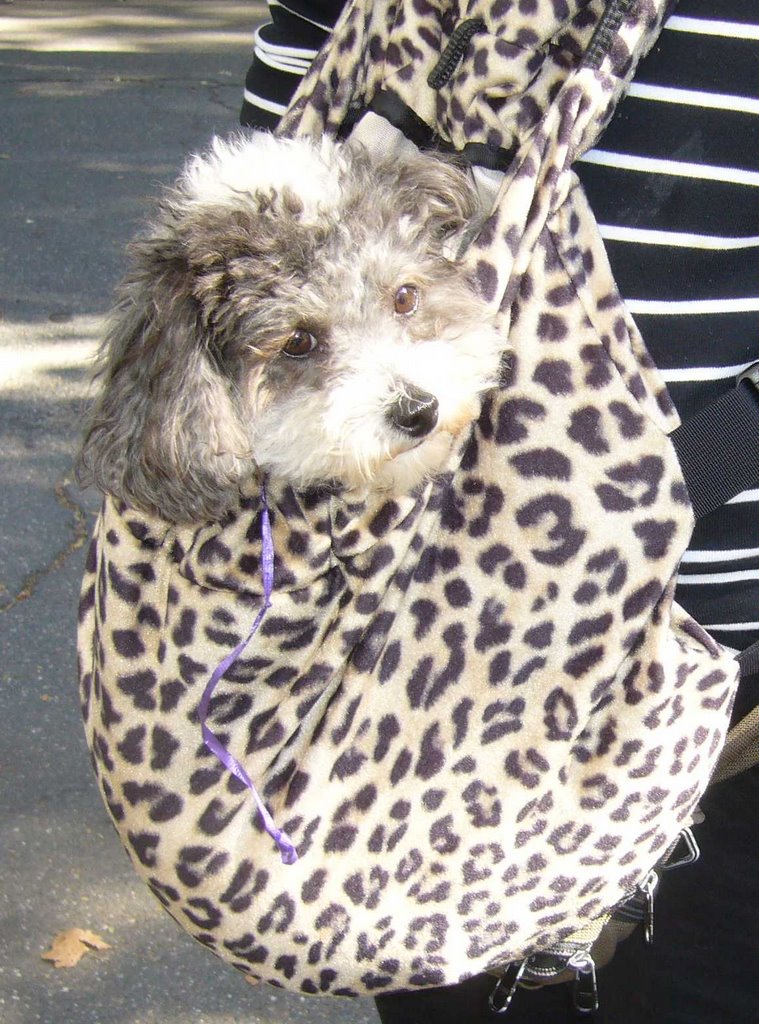
I shot a sharpei, an English bulldog, a long-haired chihuahua, a cocker spaniel, a German shepherd, a French poodle named Babette, a pair of corgis, a three-legged flat-haired retriever, a toy poodle, a bichon frisée, a Maltese, a pug, a pekinese, a miniature pinscher, and an assortment of adorable mixed-breeds. But my favorite was this one, MeToo, whose human companion identified her as a "helping dog."

The woman suffers from panic attacks, and the dog is trained to lick her face whenever an attack comes on, which calms her down. Since getting MeToo, she no longer needs medication.

I'm thinking a dog like this deserves a book all to herself.

Labels: , , ,