A Luminous Halo

"Life is not a series of gig lamps symmetrically arranged; life is a luminous halo, a semi-transparent envelope surrounding us from the beginning of consciousness to the end." --Virginia Woolf

My Photo
Name:
Location: Springfield, Massachusetts, United States

Smith ’69, Purdue ’75. Anarchist; agnostic. Writer. Steward of the Pascal Emory house, an 1871 Second-Empire Victorian; of Sylvie, a 1974 Mercedes-Benz 450SL; and of Taz, a purebred Cockador who sets the standard for her breed. Happy enough for the present in Massachusetts, but always looking East.

Friday, February 29, 2008

Word of the Day: Bissextile

Today is leap day, but it's not, really. February 29th is sometimes referred to as an intercalary day; intercalation is the insertion of a day into the calendar. Pretty obvious. But leap day is also a bissextile (Latin for "twice sixth") day. "Bissextile" is so much more obscure a word and, therefore, inherently cooler.

In the Roman calendar, on which ours is based, the year used to start in March. (Note that "September" means "seventh month," "October" means "eighth month," etc. That only makes sense if you start counting in March. Before the Caesars renamed July and August, they were Quintillus and Sextillus.) February was the last month of the year, which is why the extra day ended up there.

The calends was the first day of the ancient Roman month, from which days were counted backward to the ides, which was the 15th or 13th of the month, depending. In a leap year, the sixth day before the Calends of March (i.e. 24th February, counting back from the beginning of March) occurred twice. So February 25 was called a bissextile (twice sixth) day. That was the added day, not the last day of the month, although adding a day partway through the month gave that month a 29th day.

I feel sorry for February. With the Caesars hogging extra days for their months, even on a leap year it's the shortest month. I think the extra minutes, seconds and milliseconds should be hoarded up and, once every million years or so, February should have 32 days.

Labels: ,

Sunday, February 03, 2008

Word of the Day: Umami

Taste is a complicated phenomenon whose study goes back to Aristotle or beyond, depending on which culture you're examining. The tastes we in the Western world usually identify are salty, sweet, sour, and bitter. Those are identified by sensory receptors on the tongue, which change chemical signals to electrical potential and send this to the brain via the nervous system.

Of course, flavors are much more complicated than merely a combination of those four sensations. The mouth also senses temperature, astringency, spiciness, thickness or "mouthfeel," and so on, which contribute to our perception of taste. And of course most of what we perceive as flavor actually comes from the olfactory cells in our noses, which can recognize something like 35,000 smells.

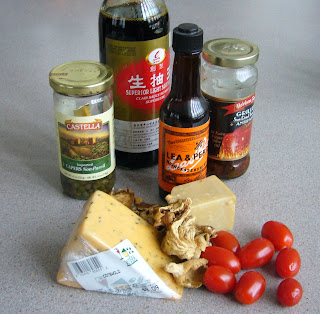
Umami--Japanese for "essence of deliciousness"--is sometimes called the fifth taste. Umami describes the hearty or savory sensation common to meats and cheeses, for example. It refers to the detection by specialized receptors on the tongue to the amino acid glutamate. Capers, soy sauce, ripe tomatoes, mushrooms, fish stock, oyster sauce, nuts and anchovies are all high in glutamate.

Glutamic acid was isolated in 1866 by German chemist Karl Ritthausen and developed as a food additive in 1908 by Tokyo Imperial University professor of chemistry Kikunae Ikeda. It's Ikeda who came up with the term "umami."

Dr. Ikeda went on to patent MSG (monosodium glutamate) and joined with the Suzuki Pharmaceutical Company to manufacture it as Aji-no-moto seasoning. In the U.S., the best-known brand is Accent. MSG became increasingly popular internationally until the 1970s, when controlled studies showed its toxic potential. Although most companies voluntarily removed MSG from their products around that time, they continued to use MSG-containing ingredients such as autolyzed yeast and hydrolyzed vegetable protein. These "hidden" sources are called "clean-label" ingredients.

Unless you grow your own food, it's almost impossible today to stay away from umami. Almost every processed food except sweets contains glutamates. Crops are sprayed with it, and it's added to vaccines, IVs, pharmaceuticals, and cosmetics.

Why would you want to stay away from it, though? Umami means deliciousness, after all. Well, for one thing, it's been linked to adverse reactions in people with allergies, autism, and seizure disorders. "Clean labelling" makes it a nightmare for those with medical or health concerns to get accurate information about the food they're purchasing.

And suddenly, umami is the new hot thing. Chefs are creating "umami bombs" of flavor. Whole books are being written about it, as though fish sauce hasn't been around since the Romans. And that's all fine. I personally love rich, hearty flavors and don't have any known sensitivities to foods. I've been preparing umami-rich meals for 40 years, although nobody was labelling them as such.

But my heart goes out to those tireless mothers struggling with autism, epilepsy, food allergies, and the like, who put so much effort into healthful diets for their children. And to those parents who aren't knowledgeable about diet issues, and are bewildered by the symptoms their children display, and can't even put two and two together because the food lobbies surpress so much information.

Parmesan cheese...good. Capers...good. Soy sauce...good. Food fad masquerading as fabulous new discovery...yawn.

Labels: , ,

Friday, December 28, 2007

Word of the Day: FUTON Bias

Ask anybody under 30 a question he can't answer, even something as simple as "what's so-and-so's phone number?" and he'll invariably google it. Even if the phone book, or the dictionary, or the collected works of Edgar Allan Poe is sitting right there, the internet will be the medium of choice. If Nicholas Negroponte has his way, soon everyone on the face of the earth will have a laptop, and a Maasai child will be accessing information the same way as a Southern California teen or a Norwegian businessman.

The implications, for research, of this flight to the net are enormous. In a way, of course, it's great. A staggering amount of information is online. But not everything. And what that means for research is that anything which is NOT online is being ignored. That's FUTON bias.

FUTON stands for "FUll Text On the Net." It's a term coined by Reinhard Wentz of the Imperial College Library and Information Service, Medical Library, Chelsea and Westminster Campus, London, in a 2002 letter to The Lancet, a UK medical journal. His concern is specifically for medical research not available online; he feels it will increasingly be ignored. He encourages publishers of medical journals to make the content of their journals available as full text "to avoid losing out to their competitors."

Wentz correctly observes that this bias is mainly prevalent among junior staff and students with limited experience in doing searches. However, the net is rapidly producing a new generation of scholars who, even as they age and gain experience, will not learn to do comprehensive (i.e., extending to traditional print-based studies) searches.

A related problem, which concerns me and which I've blogged about here in the past, is that information replicates wildly online--and so does misinformation. Once something is stated erroneously or misquoted, it takes on a life of its own. Copied and pasted, cited and re-cited, it's soon so proliferative that it appears authoritative.

Even if information is accurate, it's so easy to pull off the web that content providers routinely plagiarize whole articles, not even bothering to reword. Lift a whole phrase out of just about anything online, stick it into google with quotes around it, and up will pop all of its incestuous offspring. Or maybe it's the offspring. Only the savviest researchers can tell the difference.

Lucky for all of us that librarians, the keepers of the information, are paying attention.

Labels: , , ,

Friday, December 07, 2007

Word of the Day: Theremin

A theremin is a musical instrument, unusual in that you don't have to touch it in order to play it. It was invented in 1919 by Russian physicist/musician Lev Sergeivich Termen (a.k.a. Léon Theremin). Although a skilled thereminist can play traditional melodies with it, it's most famous for the production of those eerie sounds in science fiction and horror movies.

You can hear the theremin in the soundtracks of such productions as The Day the Earth Stood Still, The Lost Weekend, or My Favorite Martian. (That was the theremin you heard every time Uncle Martin levitated.) The Rolling Stones used it, Simon and Garfunkel used it, Led Zeppelin used it. Also a couple of my very favorite bands: The Pixies and The Mars Volta.

The theremin has two antennae. One controls pitch and the other, volume. Waving your hands around the antennae creates the sound. In theory it's easy; in practice, extremely difficult. Hand movements must be very exact, while the rest of the body remains absolutely still.

The theremin is the nerd instrument par excellence, more fun to build than a ham radio. In the 1950s, Robert Moog built one while he was a student at the Bronx High School of Science. The rest is history.

Labels: ,

Thursday, May 31, 2007

Word of the Day: Turophile

A turophile is a lover of cheese. I'm a turophile, I guess you could say.

A turophobe is one who hates or fears cheese. My daughter, who is a strict vegan, is certainly not afraid of cheese, but she avoids it completely, so I guess you could call her a turophobe.

A turophiliac, on the other hand, is one who has an abnormal fascination with cheese. Not so good for the arteries. Brian, are you listening??

Labels: , ,

Thursday, May 24, 2007

Word of the Day: Akrasia

Akrasia (literally, "bad mixture") is the state of acting against one's better judgment; i.e., weakness of the will. This concept is fundamentally illogical. One might argue--as Socrates did, via Plato's Protagoras--that if a person understands fully the impact of his actions, the course he ends up choosing will be the "right" course, q.e.d.

The subject of will, free or otherwise, is such a can of worms I don't even know why I'm discussing it here. I've been struggling with the issue of hard vs. soft determinism since I was eighteen, and it gives me a headache even to think about thinking about it. So I'm not going to start talking about Aristotle's critique of the Socratic position, or Nietzsche's, or Spinoza's, or anyone else's. I'm quite sure, in any case, that some utilitarian or pragmatist will be unable to resist weighing in with his position, effectively doing my job for me.

I think the concept can best be approached by a consideration of long-term vs. short-term gains. Lots of competing desires have to get factored into the making of even the simplest decision, and at any given point one or another may be dominant for a variety of reasons. For example, I know that, in the long run, eating a healthy diet is the "best" course of action. A pint of Haagen-Dazs, on the other hand, will satisfy me in the short run. Short-term goals are in my face; they clamor for attention.

Edgar Allan Poe, one of my favorite favorite authors, personifies akrasia brilliantly as "the imp of the perverse." It's this imp that causes us, while looking over a precipice, to contemplate jumping off, or while handling a sharp knife, to contemplate stabbing ourselves or another. Who hasn't had these frightening, unbidden thoughts at some point? He also describes vividly my personal bête noire, procrastination. Why am I playing freecell when I have a deadline fast approaching? A deadline on an article so well-paid that it will take care of my mortgage and almost everything else for the month, and which is not even a difficult assignment? Why, in fact, am I posting to my blog at this moment instead of working??

Labels: , , , , , ,

Tuesday, April 17, 2007

Word of the Day: Subfusc


Subfusc, from the Latin subfuscus, means dark or dull in color. As a noun, it refers to the (dark) clothing traditionally worn under the academic gown at Oxford. University regulations define subfusc clothing as:

For men:Dark suit and socks, black shoes, plain white shirt and collar, white bow tie.

For women:Dark skirt or trousers, white blouse, black tie, or ribbon, black stockings and shoes and (if desired) a dark coat.

Subfusc is also mandatory at Oxford during examinations. A mortarboard must be carried, but must not actually be worn. Students not complying with dress regulations are turned away from examination rooms by University police.

There's a movement afoot at Oxford to abolish the wearing of subfusc. Arguments against it range from "it's sexist," and "it puts an unfair burden on needy students," to "it encourages the [notorious] food fights that take place after the last exams." In a poll taken last year, however, 81% of Oxford students voted to continue the mandatory wearing of subfusc.

In defense of the tradition, the Honourable Aubrey Saxby-Rumpole has written a stirring editorial in The Oxford Student. While wearing subfusc, he says,"You become a member of an ancient, largely in-bred and increasingly marginalised elite. As a non-Cameronite Conservative I am all in favour of that. Oxford should not allow itself to become like those ghastly provincial hives of mediocrity; Cambridge, for example, where male students attend examinations dressed in Bermuda shorts and army surplus jackets." Hear, hear!

Labels: , ,

Friday, July 21, 2006

Word of the Day: Egregore

An egregore is a psychic or astral entity, the spirit of a group or organization. An egregore acquires its definition and draws its power from the members of the group, but the egregore may be stronger than all the members individually, and may persist after all the members have left the group or died. A club, a political party, a nation may all have egregores.

I was reminded of this word yesterday when I attended the Yardbirds concert. This group has been around since 1963 in various incarnations. Eric Clapton, Jimmy Page, and Jeff Beck all came and left; the band disbanded and reformed; many other strong musicians--Top Topham, Keith Relf, etc., etc., etc.--came and left. The current lineup is Chris Dreja on rhythm guitar and Mike McCarty on drums (original band members), Billy-Boy Miskinnon on vocals and harp, John Idan on bass, and Ben King on guitar. But even with this radically revised lineup, the sound was still 100% Yardbirds.

The group covered several classics: "For Your Love," "Dazed and Confused," "Over, Under, Sideways, Down," "Happenings Ten Years Time Ago," and so on. Also a lot of new stuff, which had the same mix of bluesy base with psychedelia, straightforward openings with multiple changes, building up the tempo to change gears and then change again, jazz-like improvisation and unbelievable virtuoso guitar solos. Ben King, who's so young even his parents might not have been fans of the original group, is like a young Clapton or Beck, and Dreja and McCarty are the same as they ever were, only more experienced. Idan's from Michigan, but couldn't look or sound more mid-sixties British, and Billy-Boy's spot on as well.

The group played with the energy they've always been famous for. Dreja and McCarty are old, but they don't look mummified like some of their peers I could name. The Yardbirds weren't stuck-up and distant; they weren't over-the-hill and pathetic. They were friendly, professional, in their element, and connecting with the audience. Obviously having a ball and taking everybody in the Square right along for the ride. Hilton Valentine, former guitarist for The Animals, who lives fairly close by, popped in at about the third song and joined right in. Free concerts four blocks from your house don't get much cooler than this.

I'm old enough to remember the Yardbirds when they first became popular. This concert took me right back to 1967...the Club Écossais in Paris...clubs in London with no name and no sign. Mary Quant eye makeup...two pairs of false eyelashes...Sassoon haircut...black stockings...high boots...minidress...dangly earrings. The vibe was perfect. The egregore was that powerful.

Labels: , , ,

Tuesday, May 23, 2006

Word of the Day: Catadromous

Catadromous means migrating from freshwater to the sea to spawn. It's the opposite of anadromous, which is migrating from saltwater to freshwater. The term which encompasses both is diadromous.

Salmon and shad are anadromous. Eel are catadromous. The eel is a declining, nearly endangered fish, for reasons which are not well understood. But one factor is certain: river dams. Eels can't get over them, and this limits their habitat.

The manmade solution to helping eels conquer this manmade obstacle is the eelway. An eelway is a pegged ramp up which eels can wriggle. It leads to a box filled with water, which houses the eels until they can be transported upstream past the dams.

Eels are an important part of the Connecticut river ecosystem. The Connecticut River has gone, in the past thirty-odd years, from "the nation's best landscaped sewer" to a clean and vibrant waterway. The Connecticut River Watershed Council constructs and mans eelways on the river. And they work for the removal of "dead beat dams"--those which no longer serve a community purpose. Props to these advocates for the catadromous!

Labels: ,