
A Luminous Halo

"Life is not a series of gig lamps symmetrically arranged; life is a luminous halo, a semi-transparent envelope surrounding us from the beginning of consciousness to the end." --Virginia Woolf

My Photo
Name:
Location: Springfield, Massachusetts, United States

Smith ’69, Purdue ’75. Anarchist; agnostic. Writer. Steward of the Pascal Emory house, an 1871 Second-Empire Victorian; of Sylvie, a 1974 Mercedes-Benz 450SL; and of Taz, a purebred Cockador who sets the standard for her breed. Happy enough for the present in Massachusetts, but always looking East.

Monday, April 16, 2007

Tutte le Opere di Nicolo Machiavelli

Recently I've been cataloging some very valuable books, unusual ones for me in that they are not Judaica. Every once in a while the bookseller I work for, Dan Wyman, will acquire an interesting lot which falls outside his specialty. One time it was gay and lesbian comics from the '60s. Another time it was material related to the water industry in New York state (sounds boring, I know, but would you believe a post-war propagandist romance, in which the heroine's fiancé tries to sabotage a dam in upstate New York, nearly taking her life in the process, but she--and the dam--are narrowly saved by a brave civil engineer, with whom she falls in love and lives happily ever after?)

This week it's a miscellany of rather old, very collectible books. Lots of vellum, rag paper, raised bands on the spine, all edges gold, and so on. This particular volume is the complete works of Machiavelli, with no publisher's name or location, but a date at the bottom: MDL. (For those whose knowledge of Roman numerals is rusty, that's 1550.)

Or is it? In fact, this book was probably printed by Pierre Aubert in Geneva around 1640 or 1645. Aubert was responsible for several editions around that time, and used the same imprint--1550--as an earlier edition. And left off any mention of his publishing house or its location.

So how on earth are you supposed to know this? Experience. Famous works like this one have entire volumes devoted to research on the various printings and the provenance of extant copies. Pagination errors, blank leaves, and variations in signatures (letters, numbers, or symbols at the bottom of the first page on each sheet of printed pages of a book as a guide to the proper sequence of the sheets in binding) are used to distinguish otherwise identical editions.

My kids find my predilection for cataloging hilarious. To them, it's an activity of mind-numbing drudgery. I prefer to think of it as detective work, without emphasis on the sordid side of human nature. Detective work I can do in my bathrobe, if I so choose.

This edition of Machiavelli will probably fetch $2000 to $4000. It's centuries old, and has probably been to more--and to more interesting--places than I have. What I do know about this object is tantalizing, and not a drop in the bucket of the whole history with which it is embued.

Labels: , ,

Sunday, March 04, 2007

Silly Sitcom Situation

I was awakened this morning by a phone call from someone I hadn't seen or heard from since 1965. This high school acquaintance, now living thousands of miles away, was back in town helping her mother organize a move to a kinder climate. A mutual friend (someone I have kept in touch with over the years), told her I was nearby, computer literate, and had a nice camera. My Long Lost Friend was desperate for a favor.

The all-too-common tensions with relatives were surfacing around this move, specifically over "stuff." Who gets what, in other words. In-laws were battling, Mom was getting extremely upset, and my friend (let's call her Susie to protect the innocent) was getting a lot of grief, despite her having taken a month-long hiatus from her high-powered career in order to help out.

Susie had been informed that all the family photographs were being shipped off, and she wasn't allowed to have any of them or even to make copies. Of course it was possible that tensions would abate, the rift would heal, and the recalcitrant in-law would graciously scan everything and send it on to her, but possession is nine-tenths of the law and Susie wasn't taking any chances. While she was in the same house as the photographs, she wanted to have copies made, just in case things got worse and not better.

Time was of the essence. The albums couldn't leave the house. Mom couldn't know what was up. Could I come right over with my camera? Our mutual friend (let's call her Anna) would pick me up within the hour.

Well, I'm easy. And always up for other people's harebrained schemes. Anna showed up with a camera of her own and we zipped over to Susie's. Susie let us in surreptitiously and went back to keeping Mom busy in the bedroom, sorting sweaters, while we tiptoed into the dining room to snap pictures of pictures.

Now, I distinctly remember the phrase "a couple of dozen pictures" uttered casually over the phone. In fact, there were a couple of dozen albums, plus several cartons of framed photographs. Unquestionably thousands of pictures all together.

Anna and I pulled out our cameras and, hearts racing and ears pricked for sounds of footsteps, a session of furtive and furious snapping began. Snatching framed items from the cartons, whispering frantically, we clicked and clicked, cursing the poor light, the reflecting glass, the curled edges, the stubbornly wrinkled plastic film on the album pages. We were boat people on a sinking ship, Cherokees about to leave on the Trail of Tears, pioneers whose oxen had given out, desperately trying to save the last, most precious mementos.

Before we could complete our task, Susie was back, pantomiming an exit. We had to leave, right that minute. We would take some albums with us and finish at home. She assembled a large moving box and filled it with albums, motioning Anna to help her lug it to the car. Obediently, I followed. Back in my kitchen, I spent the entire afternoon taking pictures, burning the results--close to a thousand pictures--onto CDs.

My daughter was indignant. You're too nice, Mom, she said. Dropping everything for someone who comes out of the woodwork and needs a favor. Not accepting money for a huge project which takes your professional expertise. Documenting artifacts is what you do for a living!

She's right, I suppose. Cataloging Judaica involves, among many other things, scanning or photographing every item. Sometimes I do large collections of community history. A commemorative booklet from a synagogue in the Andes, listing the names of all the founding families of a tiny outpost of Jewish immigrants, is invaluable material for scholars trying to reconstruct history, especially when so much and so many have been destroyed in the Holocaust or during other violent periods.

Perhaps because I do so much of this kind of work, I could sympathize with my friend. In one day, I followed her family history, from studio portraits of turn-of-the-century immigrants, to her mother's babyhood, to black-and-white snapshots from the forties and fifties, to Susie's school years captured on Instamatic and Polaroid color film, to orangey and degraded '70s shots of her early marriage and babies, to rolls of Kodachrome from her empty-nesting parents' vacations. I recognized the Rockport rocks where I vacationed as a kid, the same prom I attended in high school, her closest friends who were also my schoolmates. All I ask in return is a leisurely date for coffee or lunch before Susie flies out again so we can catch up--without any references to the current stressful situation--on what we've been doing for the last forty years. Putting captions on all those pictures, so to speak.

Labels: , , ,

Monday, November 13, 2006

Out of Town

Because people know I'm a book cataloger and a bibliophile, I'm occasionally given old books by friends and relatives. Books acquired for little or nothing, which the donor doesn't quite know what to do with, but thinks might have some value.

"Hmm, maybe Cicily would want this decrepit but kind of interesting old book."

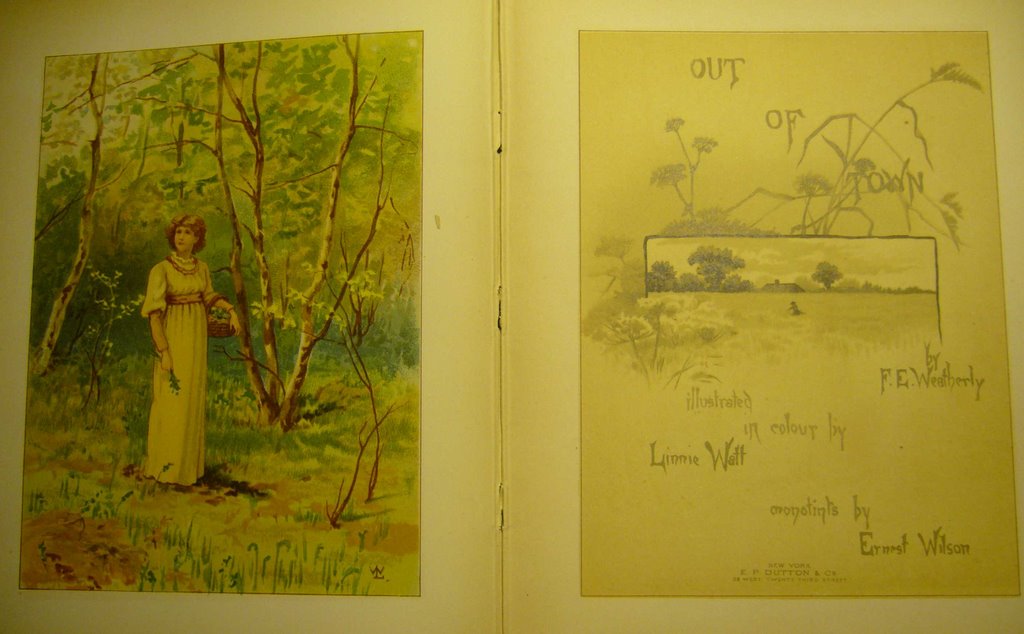
That's how I came upon this copy of Out of Town by F. E. Weatherly. One of my cousins picked it up at the Goodwill and passed it on to me. "It's falling apart," she said, "but the pictures are nice, and maybe you could cut it up and frame them."

Her place is tiny, and she shares it with one of those guys who's really talented but not at all ambitious...one of those guys who'd rather be fishing or smoking weed than working. Every square inch of the place is covered with his aquariums and his marionettes, or has a cat draped over it. I, on the other hand, live with my two minimalist sons in a cavernous Victorian. Loads of 10-foot-high walls on which to hang framed prints from picture books.

Of course, I checked the value of the book when I got it home, and sure enough, it 's worth some bucks. The cheapest copy for sale on the net is $90, and they go up to almost $200. None seems to have the poor binding that my copy has, but that's not really a huge issue with old books, as many people don't realize. It's more important for the interior to be in good condition. Underlining, evidence of library ownership, bookworm damage, water damage and so on are more serious flaws--things that can't be rectified by rebinding.

Frederic Edward Weatherly was an Oxford-trained lawyer, but more famous as a songwriter. He was prolific, with over 3000 songs to his credit. The one everybody's heard of is "Danny Boy." Out of Town is a book of poems, lyrical, as one might imagine. It was published in 1880.

This book has not one but two illustrators. Linnie Watt, a painter who's not totally lost to history, did the lovely chromolithographs. Ernest Wilson did the monotints, which are charmingly integrated with the text. In the poem "Two O'Clock," which begins, "Sing a song of two o'clock, Tadpoles in a pool," the capital "S" is a tadpole. The "Y" which begins "Gentleman John" is a rake. Leaves and branches twine all around the text; a crab hangs by a pincer onto a poem about the seashore.

I haven't got the heart to cut the book to pieces, and of course now I know it's worth more money in one piece. Anyway I've got literally dozens of paintings, photographs, and mirrors yet to be hung--I don't need any more. Out of Town has come to the right place--a creaky old house where everything, including the owner, is vintage, and being old and a little worn out is just the way to be.

Labels: , , , ,

Friday, June 23, 2006

Indian Orchard Mills

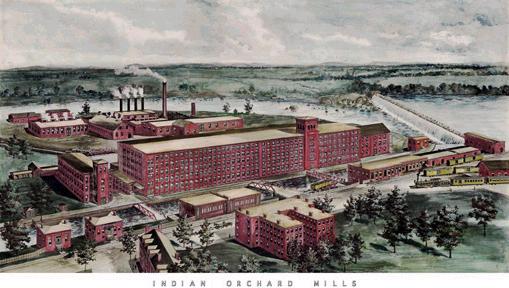
This is the home of Dan Wyman Books, source of all the Judaica I catalog. Inside this building, up on the fourth floor, in the back, is where all the books live when they're not visiting the Emory House. I've got perhaps a thousand scattered all over my house; Dan's got tens of thousands shelved in here.

The Mills a century ago was the largest employer in Indian Orchard. A canal diverted water from the Chicopee River through penstocks and past turbines to power the machinery in the mills. With the railroad passing in front of the complex, the river behind, and Main Street only a block away, the Indian Orchard Mills was a hub of activity.

The Indian Orchard Manufacturing Company, owner of the mills, was responsible for much of the infrastructure at the time, donating land for schools, libraries and parks. These mills, other mills located on the same river but closer to Ludlow, and the Chapman Valve Company were the main employers of Indian Orchard in the nineteenth century. They attracted many immigrants to the town in the 1890's and in the early 1900's. Irish, Poles, and French Canadians made up the bulk of this immigrant population.

The Mills eventually languished as manufacturing in the Northeast declined. Today, however, the Mills is once again a pretty vibrant place. Up on the fourth floor with Dan are a piano restorer, a jeweler, and a pocketbook maker, among others. Below us are furniture builders, screen printers, die cutters...name your trade; we probably have it. Next door is a moving company; behind us are artists' lofts. Spring and fall the artists hold an opening, with wine, cheese, a little music combo--very laid-back and cool.

Dan has trouble finding helpers willing to work in the warehouse, bookkeepers particularly. One recent new hire who was visualizing, I guess, a chatty office complete with water cooler, lasted two days. She said the place creeped her out. I like it, though. I make a pot of coffee and listen to blues from one tenant's radio mingled with Brenton Evans testing his pianos with Chopin and Dvorak. Above me, someone is hammering; below me, someone else is drilling. It's the sound of people being useful and productive. What's not to like?

Labels: , , , , ,

Thursday, April 06, 2006

The Blue Castle

The Blue CastleHere's a book I took off the free shelf at the Springfield Main Library. I help myself to a few periodically, and usually return them once I've read them. I love to read and eat, but I'm always afraid I'll splatter a valuable book, so these throwaways comprise my usual lunchtime reading.

The Blue Castle is the story of mousy old maid Valancy Stirling. She's misdiagnosed with a fatal heart disease, and the belief that she's going to die soon gives her the courage to break out of her stifling existence.

The "blue castle" which gives this book its name is the fantasy place Valancy has created in her imagination. She spends more time in her blue castle than she does in the prim and ugly house she's trapped in with her uptight mother and icky Cousin Stickles. The castle is located in Spain, and has a rotating band of suitors, whose looks and personalities change as Valancy matures. Of course, by the end of the book, Valancy has found a real blue castle, complete with a cool guy who has a couple of enchanting secrets of his own.

I love these sweet g-rated stories from between the wars. But I'm accumulating so many old books that I don't have enough shelves to put them in, or even enough walls to put shelves up against if I did have them. So I made up a pile the other day of books I hadn't ever even paid for, and consequently shouldn't feel bad about giving away again.

Just out of curiosity, though, since I'm a book cataloger and know exactly how to determine the value of a book, I took this one upstairs to my loft and checked it out online. That's when I realized that "L.M. Montgomery" was Lucy Maud...author of the "Anne of Green Gables" stories. Better still, this was a first edition (1926), worth between $250 and $450.

It's wasn't a library discard, just a book someone had stuck on the shelf. So there's no way to trace the former owner. I guess I'll just have to hang onto it. Maybe loan it out to a trusted friend--but only on the condition that no messy food is consumed around it.

Labels: , ,

Tuesday, April 04, 2006

CLAC If You Love Books

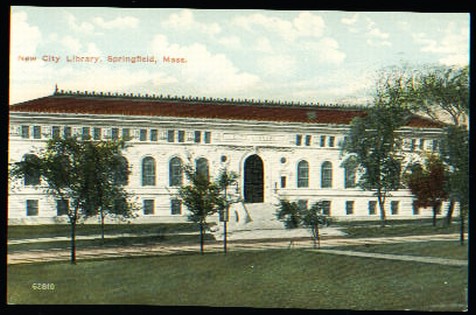
Springfield Central LibraryTonight was the second meeting of the Central Library Advisory Committee, of which I'm a member. I've been trying to ease up on the volunteer commitments; I have to quit acting like a suburban matron with nothing else to do. In fact, I'm a struggling single mother with two kids still at home and little visible means of support. As such, I need to be limiting myself to things I get paid to do, at least until further notice. But I couldn't say no to the library. Sheila McElwaine, the Library Commissioner, called me herself and asked me to sit on the committee. Probably because I was president of the Armoury-Quadrangle Civic Association--but my term was up last week. So now I'm just a concerned citizen, balancing my genuine concern for the state of affairs of the neighborhood with my fear of being named to too many sub-committees.

We've been talking about our hopes and dreams for the library. Most members seem to want the library to become a real community meeting place. Somewhere kids can go to do homework, or where neighborhood associations can hold meetings, for example. We've been talking about advertising the free movie series more heavily, giving tours of the building, setting up a coffee bar.

None of those is a bad thing. But when my turn came to speak, I didn't speak about community. For me, a library is all about the books....or whatever form the information comes in these days. When I walk into a library, I expect to be able to find whatever I'm looking for. On the shelf, in the stacks, on microfiche, online, through inter-library loan, whatever.

When I lived in Wilbraham, I used the town library as an extension of my own bookshelves. When I wanted to make a fabulous dessert for a party, I'd go straight to the stacks and grab Maida Heatter's chocolate cookbook. Every spring, I would borrow Josephine Nuese's The Country Garden. I didn't have to look up the call numbers; I knew exactly where each book was shelved.

One day I went looking for The Country Garden, and it wasn't there. I couldn't ask the librarian if it was checked out, because I couldn't even remember the title. Just the look of the spine and the spot it should've been in. I sat in a chair and concentrated until the name came to me. Then I looked it up in the card catalog to get the call number for the librarian. But it wasn't in the catalog.

It dawned on me then that the library had discarded the book. And that was just the beginning. One by one, the books I had been taking out year after year began to disappear. The old-school cake decorating book with the recipe for "stabilized" whipped cream. The Polish-American cookbook with the cheesecake identical to the one Chmura's Bakery used to make. The librarian told me that they were weeding out books according to frequency of withdrawals, to make room for the flood of new acquisitions.

That method of culling the herd disturbs me greatly. Currently I'm reading Arabian Sands, by Wilfred Thesiger, published in 1959. Since I'm a book cataloger, I look at every book I pick up with a professional eye as to its value. This particular library book is a first edition, with the large folded map still tucked into a pastedown on the inside back cover. No dust jacket, and library ownership marks, which are drawbacks, but still a valuable copy. Not too popular these days, however. I wonder if the days of this masterpiece of travel literature are numbered.

Anna Brandenburg, the reference librarian, assures me that Springfield has a more intelligent way of earmarking discards. And that many items taken off the shelves are stored in the basement stacks. That's the good news. The bad news is, Sheila McElwaine thinks I'd be the perfect person to head up the Collections Sub-committee.

Labels: , ,