
A Luminous Halo

"Life is not a series of gig lamps symmetrically arranged; life is a luminous halo, a semi-transparent envelope surrounding us from the beginning of consciousness to the end." --Virginia Woolf

My Photo
Name:
Location: Springfield, Massachusetts, United States

Smith ’69, Purdue ’75. Anarchist; agnostic. Writer. Steward of the Pascal Emory house, an 1871 Second-Empire Victorian; of Sylvie, a 1974 Mercedes-Benz 450SL; and of Taz, a purebred Cockador who sets the standard for her breed. Happy enough for the present in Massachusetts, but always looking East.

Saturday, December 16, 2006

Barkfest

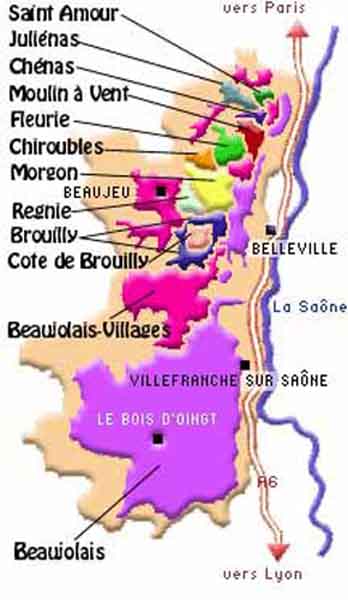
I'm starting to write an article about Beaujolais--not the cheapo, just-arrived Beaujolais nouveau of the third week of November, but the pricier Beaujolais crus that improve with age. A cru in French is a vineyard; with respect to Beaujolais, the term refers to the ten areas in the Beaujolais region where these potentially excellent wines are made.

The ten appellations, each designating a specific area in the region, are: Brouilly, Chénas, Chiroubles, Côte de Brouilly, Fleurie, Juliénas, Morgon, Moulin à Vent, Régnié, and Saint-Amour. Typically, these wines are labelled with the individual appellation. The word "Beaujolais" may be nowhere evident on the bottle. Many consumers are therefore unaware that these complex wines, worthy of cellaring, are varieties of Beaujolais. This ignorance contributes to the stereotype of Beaujolais as an inexpensive, easy-drinking wine of little complexity.

The region itself is, like every other wine-growing region of France, picturesque and beautiful. Every square centimeter of every hectare is lovingly and painstakingly cultivated and cared for. There might be people who can visit such a place and not want to stay forever, but I'm not one of them.

My dog seems to be a bit of a Francophile, like me. She's never been to the country, but she seems particularly attuned to the language. Taz responds much better to commands in French than in English. "Do you want to go for a walk?" produces a mildly interested prick of the ears, while "Tu veux te promener?" occasions a frenzy of barking and a wild scamble for the door.

Last night I was reciting the ten Beaujolais crus to her, in alphabetical order. Taz began a volley of barking; by the time I got to "Regnié," she seemed ready to knock me down. It's hard sometimes to figure out what's going on inside the brain of a dog. Does something about the inflection of French set her off? Does it sound similar enough to commands related to joyous topics like walks and treats to frustrate her, since I'm remaining in my chair? Or--as I like to think--is she saying, "YES! Let's go! Let's go! When do we sail? Let's go!"

Labels: , ,

Thursday, March 30, 2006

Snowdrops

snowdropsI left for Umbria and Beaujolais on March 12 and I came back on March 20...the first day of spring. Before I left, I said good-bye to winter. To a freezing-cold house, a bleak yard, and a depressing litter-strewn street, which I know only too well since I have to walk the dog up and down it four times a day. I said I'd expect to see forsythia or crocuses or, at the very least, snowdrops upon my return.

So I was excited to see snowdrops before I even got home. On Saturday night, in France, at Château Pierreux, at a lovely dinner hosted by Philippe Bardet of Mommessin. Well, not snowdrops growing, but little glasses of snowdrops as centerpieces, a row of them all down the impressively long table.

The common snowdrop is Galanthus nivalis; i.e., "white flower of the snow." It's the flower that, according to folklore, sprang up from the falling snowflakes to console Adam and Eve when they were driven out of the Garden of Eden into the cold, wintry world. The flower that Odysseus used as antidote to Circe's poisonous drugs. And the subject of one of Hans Christian Andersen's horrid little fairy tales, which I won't synopsize because they creeped me out as a child and still do.

From the common snowdrop is isolated an alkaloid called galantamine. Galantamine acts as an acetylcholinesterase inhibitor; that is, it helps maintain normal levels of the neurotransmitter acetylcholine. (Acetylcholine deficiency leads to Alzheimer's disease.) Galantamine is also used to treat headache, neuralgia, polio, and other neurological conditions and diseases.

Not a bad portfolio for such a dinky little flower.

And it was snowdrops, not out-of-season hothouse flowers or exotic blooms flown in from South America, giving the finishing touch to the couvert at a meal which was classy and casual as only the French can do it. We started our meal festively with a glass of crémant, followed by a fish mousse accompanied by a 2004 Monternot Pouilly-Fuissé, then Charolais beef and a gratin de pommes de terre dauphinois with a 2004 Brouilly, a 2003 Réserve du Château, and two dusty unlabelled bottles from the cellars--a 1990 and a 1989 Réserve du Château. Proof in the glass that good Beaujolais can be held. And a lovely, gracious gesture on the part of our host....there weren't too many of those bottles left down there!

This is one of those make-or-break years for me. And the first day of spring is the beginning of the year, for Persians anyhow. So I'm going to take the little glasses of snowdrops as omens of hope for the coming year. Relaxing in the Château Pierreux after a hard day of wine-tasting, raising a glass of crémant to Pamela Wittmann and Philippe Bardet, the air seemed full of promise. If the humble snowdrop could be chez soi, why not I?

Labels: , ,