A Luminous Halo

"Life is not a series of gig lamps symmetrically arranged; life is a luminous halo, a semi-transparent envelope surrounding us from the beginning of consciousness to the end." --Virginia Woolf

My Photo
Name:
Location: Springfield, Massachusetts, United States

Smith ’69, Purdue ’75. Anarchist; agnostic. Writer. Steward of the Pascal Emory house, an 1871 Second-Empire Victorian; of Sylvie, a 1974 Mercedes-Benz 450SL; and of Taz, a purebred Cockador who sets the standard for her breed. Happy enough for the present in Massachusetts, but always looking East.

Sunday, March 11, 2007

Always Appropriate

Today was an impromptu celebration of daughter Cordelia's new job at Smith College. I had planned a casual supper of pasta e fagioli, spinach sautéed with lemon and garlic, a salad of romaine and radicchio, and basil focaccia. Cordelia's dad walked in with a nice Cabernet and, for Cordelia, a bottle of 1998 Dom Perignon Brut. Suddenly it was a party!

Ali did the honors, and when the cork popped and some champagne splashed onto the carpet, Taz was right there to clean it up. She promptly passed out under the table. We toasted Cordelia's good fortune in the notorious flutes which go "thunk!" instead of "tiiiiing."

The champagne was lively and citrus-y, with notes of biscuit and a lingering finish. The non-champagne drinkers at the table were surprised that it was 1) not sweet and 2) very palatable. Well, duh! Champagne is delicious! And always appropriate. Even with pasta and beans.

Labels: ,

Friday, January 12, 2007

Muselets

Wine afficionados often save the labels from bottles as a record of what they've consumed. They can be pasted into an album, traded, or used to wallpaper the bar. Champagne drinkers are a separate breed, however. They don't collect labels; they collect muselets.

A muselet is the wire cage which covers the cork of a champagne bottle. The pressure inside the bottle can be up to six atmospheres, about 88 pounds per square inch. Champagne is stored in extra-thick bottles, corked, and capped with a muselet for a reason. Otherwise, it might explode.

Before there was a cork, there was a wooden plug, covered with hemp and impregnated with oil. Dom Perignon supposedly got the idea, in the late 17th century, of replacing the wood-hemp-oil arrangement with something new he'd seen. Monks returning from pilgrimages to Compostella were using corks to plug their gourds. The less-elastic wooden contraptions regularly popped out; corks were more reliable.

Before there was an extra-thick bottle, there was an ordinary wine bottle. As long as they were left alone, the bottles pretty much behaved. But after 1840, when Mme Veuve Cliquot invented the process of remuage--turning the bottles a few degrees each day to settle the sediment, danger set in. The caviste or remueur had the unenviable job of rotating each bottle, set into a rack called a pupitre, by an eighth turn daily. Never mind that it was dark, dank, and freezing in those cellars. Never mind that the job was mind-numbingly boring. Playing Russian roulette with the bottles did keep you alert, but not in a good way.

And before there was a muselet, there was a hempen string tied around the corked bottle as insurance. The string was eventually replaced by wire. By the 1880's, prefabricated wire cages--the muselets--were being used. ("Museler" in French means "to muzzle.") Various shapes and numbers of "legs" around the neck were tried, before the four-legged modern muselet was settled on. A plaque on the top of the cage was stamped with the name of the vintner and perhaps the vintage, if applicable. Not until after World War II was the plaque an integral part of the muselet.

Now perhaps you're thinking, could she have found anything more trivial or more obscure or less relevant to be writing about? Au contraire, I find this kind of esoterica not only fascinating, but vital. Knowing the name of an object, understanding its history, putting it in a context gives it meaning and importance. A throwaway object acquires existence in our consciousness. With history and memory and language we construct the fabric of our existence. That's what it means to be human.

Labels:

Sunday, December 17, 2006

R.I.P. Veuve Cliquot

On a ramble through the Marne region, you will find many little markers identifying the houses to which the various vineyards belong. Vineyards are passed down in families, split between heirs, split again, then resold, so that the land becomes a patchwork. A large house like Bollinger or Veuve Cliquot doesn't own one massive area, but myriad plots scattered all over.

323 villages comprise the Champagne region. Within the region, as defined by law in 1927, a geographic area of 34,000 hectares has been strictly delimited for the production of champagne. Every conceivable aspect of production is strictly controlled by law.

For example, only three vine varieties may be planted for the production of champagne: Chardonnay, Pinot Noir, and Pinot Meunier. Spacing between rows of vines must not exceed 1.5 meters. Distance between vine-stocks in the same row must be between 0.9 and 1.5 meters. The sum of the space between rows and the distance between vine-stocks must be less than 2.5 meters. Etc., etc., etc.

Pruning methods are subject to these stringent regulations: only four pruning methods are permitted, and the method used further depends on the cru, or vineyard, and on the type of grape planted. The maximum height for the tallest vines is 0.6 meters, or about two feet. Incredibly (in fact, largely because of this strict pruning), the roots of these vines go down as far as 30 meters into the soil. The soil composition, specifically the deep chalk subsoil, is one of the main components of terroir--the range of geographic and climatic factors which give a wine its unique characteristics.

In the month of November, when I took this picture, there's no fruit or foliage on the vines. The prodigious hardware can be easily seen. That identifying marker looks an awful lot like a headstone. In fact, casual visitors often do mistake them for gravestones. But there's really nothing to mourn. Come spring, summer, and up until the vendange in mid-September, all that metal will be covered with Chardonnay, Pinot Noir, and Pinot Meunier grapes and leaves. The Veuve Cliquot may be dead, but her champagne is not.

Labels: ,

Saturday, December 09, 2006

Still on the List

The mail has been full of interesting things lately--cards, letters from old friends, checks, notices informing me that some of my money is being refunded, and so on. I was especially excited to receive this Christmas card today from "le Conseil d'Administration, le Comité de Direction et toute l'équipe du Centre Vinicole - Champagne Nicholas Feuillatte."

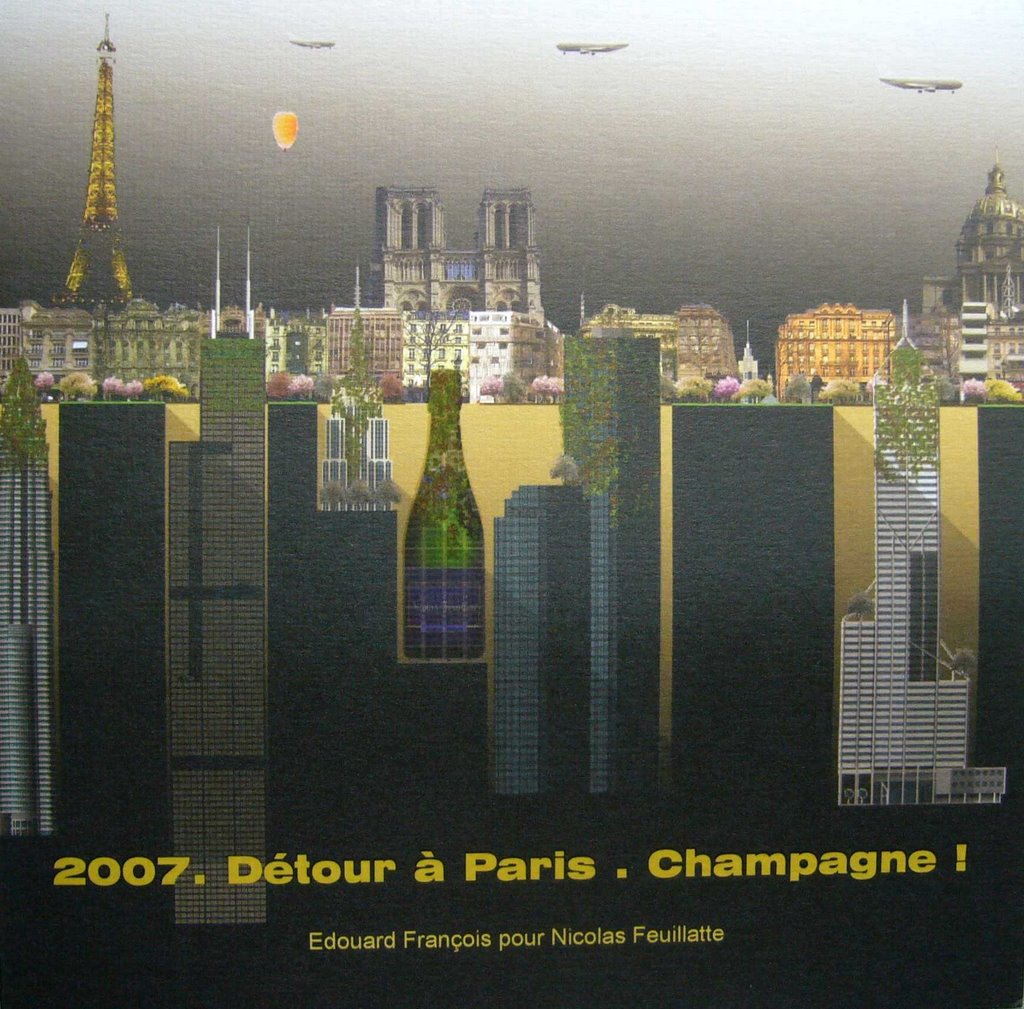
What originally intrigued me about the champagne house of Nicholas Feuillatte was its affiliation with artists. Being very young for such a company (NFCVC celebrated its 30th birthday on October 12th of this year), and also a cooperative (very untraditional for this business), NF early on decided to align itself with youth and modernity in building the company image. Accordingly, each year a contemporary artist is selected by NF to interpret a theme chosen for that year. Effervescence, terroir, and skin contact are examples of past themes. The artist produces one work which is installed in an art gallery in the Chouilly cellars. He or she also designs marketing materials for the year, including a Christmas card.

When I visited the cellars last November, I got to see the art gallery--very cool. And I was given the lovely bottle of pricey vintage champagne. I wondered if perhaps I'd get a Christmas card, but I didn't. Oh, well. Getting a little greedy, I thought.

But I began receiving lots of other mail from their PR agency--press releases and little gifts. A CD of world music, a neat little picnic carrier with room for a bottle of Beaujolais. And of course, an invite to an all-expenses-paid trip to Italy and France. Unfortunately, I was not able to pay them back in the manner they hoped, in the form of a glowing published account of the trip. None of the editors I was working with had any interest in articles about champagne, olive oil or Beaujolais.

Which means, I guess, that I should get myself some different editors. And, in fact, I do have a new editor for my weekly column. Her former post was managing editor of the lifestyle ( i.e. food, wine, travel, and so on) section of Springfield's The Republican. We've got a plan to meet after the Christmas rush. Perhaps she'll be willing to help me get my foot in the door with some food, wine, or travel articles.

I still have a chance to redeem myself with Nicholas Feuillatte and with their PR agency in New York. I got a Christmas card....that means I'm still on the list.

Labels: , ,

Friday, December 01, 2006

Champagne Taste

A little over a year ago, I wrote to the champagne house Nicholas Feuillatte, asking if I could arrange a tour of their Centre Vinicole de la Champagne Co-operative in Chouilly. I casually mentioned at the end of my note that I was a writer thinking of doing a piece on the region. That little postscript generated an exciting chain of events which climaxed today.

I never heard back from the French company directly. Instead, I got a communication from the head of their P.R. firm in Manhattan, putting themselves at my service. A few days later she wrote back with details of my tour arrangement. After I got back from Champagne, the agency kept in touch with me, eventually inviting me on an extremely luxurious press trip--airfare included--to Beaujolais and Umbria.

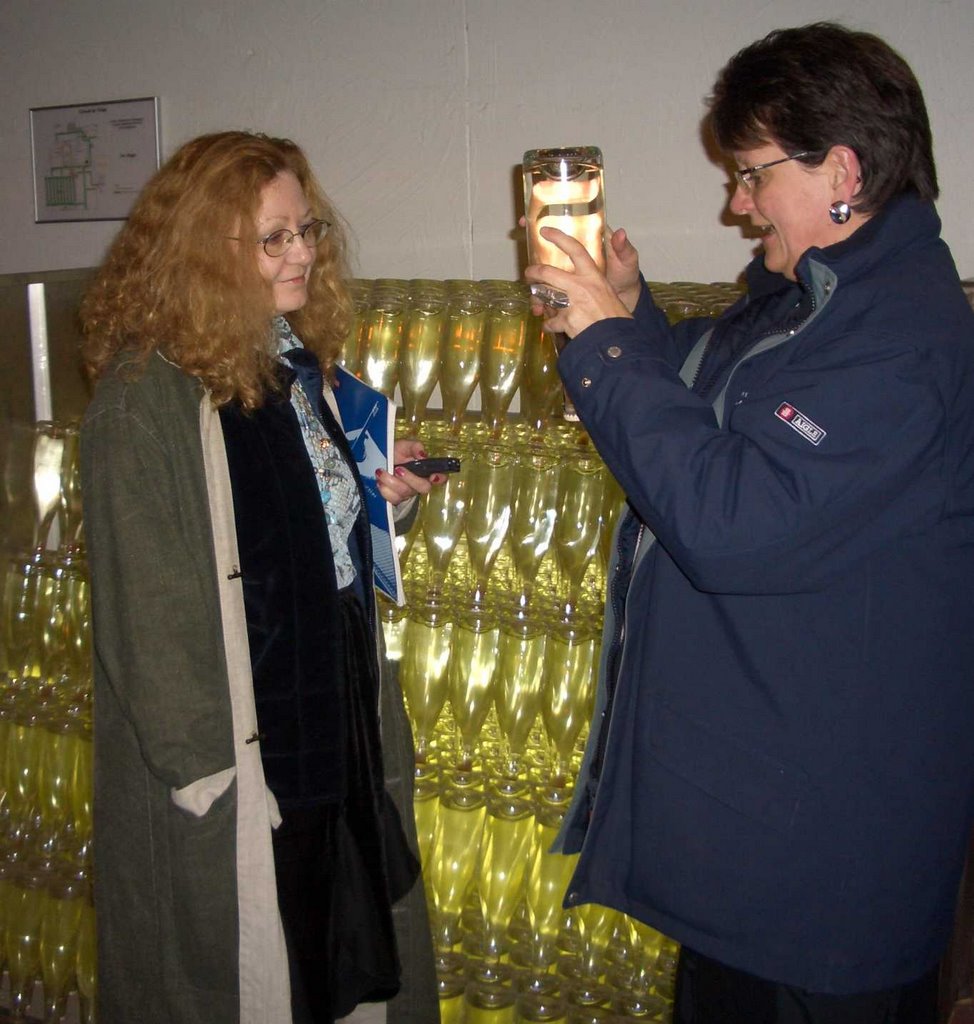
I had asked to tour the plant on a weekend, when it was not in operation. They basically opened the place up just for me. An attachée spent about two hours showing me the entire operation, after which we retired to the tasting room. She uncorked increasingly expensive bottles--four in all--for me to try. The attachée, the photographer, and I made a pretty big dent in those bottles, and were best friends by the time we got to the Cuvée Palmes d'Or Rosé.

Before I left, she presented me with "a little gift"--an attractively packaged bottle of Nicholas Feuillatte champagne. Back at the château (this trip was first class all the way!), I opened the package and discovered I had been given the 1996 Cuvée Palmes d'Or--not too shabby. I carried it home carefully, set it on my sideboard, and contemplated it frequently, asking myself what festive occasion I should mark with the opening of this bottle.

What better time, I finally decided, than the week of Thanksgiving, with so many people I love around me? So today was the day.

The vintage champagne was as good as I remembered: a beautiful, fresh floral and citrus-y aroma, elegant tiny bubbles, a pale straw color, complex flavor, with lemon predominating, long finish. Almost too easy to drink...all too soon, it was gone.

But at least I've got the beginnings of a serious wine education. Also happy memories of my experiences. And, of course, the empty bottle for my collection.

Labels:

Saturday, November 04, 2006

Enseignes en Fer Forgé de Hautvilliers

A year ago last November, I was in France, visiting the Champagne region. Everything is beautiful there. Everything. It's the most picturesque place you can imagine, because the champagne grape has been cultivated there for centuries. Champagne families are often dynasties, passing on the land for generations. What's old is venerated, respected, lovingly preserved. The only industry I spotted there, besides wineries, was wine-related: a manufactory for making the special thick champagne bottles.

Of all the picturesque towns, Hautvilliers is perhaps king. This hilly little town is classed premier cru, along with neighboring Avenay and Ay. Dom Pérignon is buried here, in the abbey church of St. Sindulphe. He's the monk who accidentally made wine with those pesky little bubbles. The rest is champagne history.

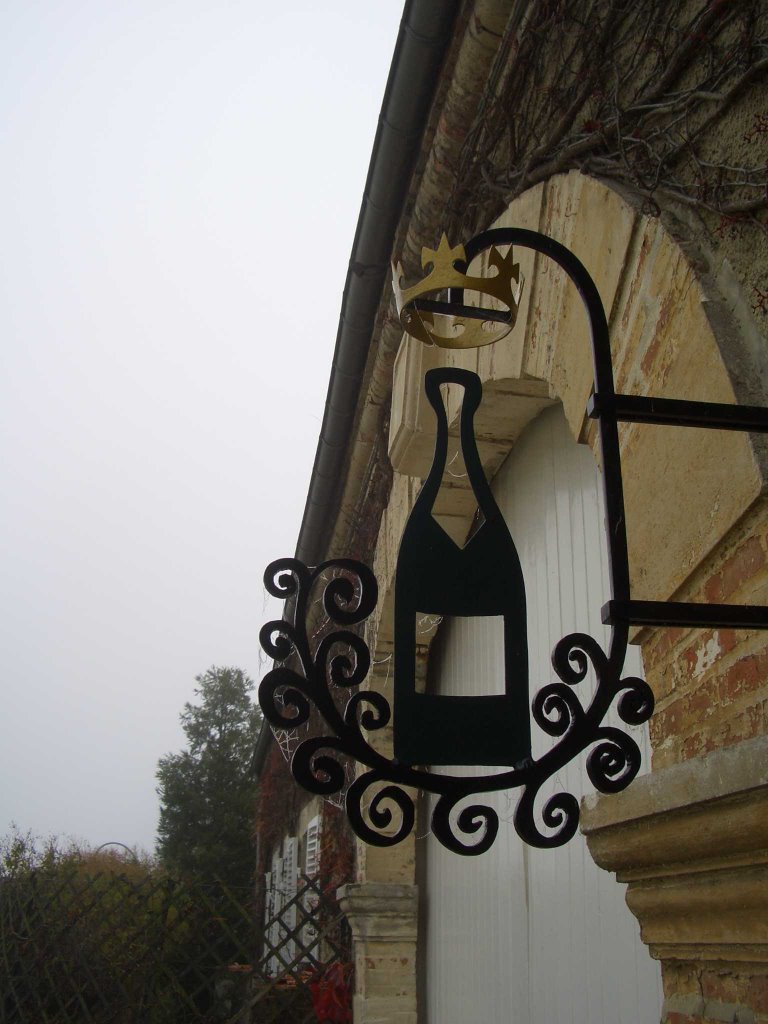
Hautvilliers is also notable for its forged iron signage. You'll find these signs sprinkled throughout France and other European countries besides, but in Hautvilliers, it's really signs gone wild. Almost every doorway in town sports an iron sign hanging above it. These pictorial signs, of course, were originally designed for the illiterate majority, and gave a clue as to what was inside. Since champagne is the only business in town, the signs of Hautvilliers are an endless variation on the themes of grapes, vines, bottles, casks, flutes, and--occasionally--happy couples celebrating.

Last year's trip was all about champagne. I didn't have the time or money to figure out where all those signs came from. I didn't notice any businesses in Hautvilliers except dozens of viniculteurs and one café.

In nearby Montier-en-Der, I learned later, is a forge called Fer et Traditions where signs, weathervanes, and the like are made. It's run by a man named Richard Brouard. Next time I'm in the neighborhood, I plan to stop by. I wonder if he'd be willing to take a break from all those iron grapes and tendrils to make something for an American. Maybe a shelf of books with cockador rampant?

Labels: , , ,