
A Luminous Halo

"Life is not a series of gig lamps symmetrically arranged; life is a luminous halo, a semi-transparent envelope surrounding us from the beginning of consciousness to the end." --Virginia Woolf

My Photo
Name:
Location: Springfield, Massachusetts, United States

Smith ’69, Purdue ’75. Anarchist; agnostic. Writer. Steward of the Pascal Emory house, an 1871 Second-Empire Victorian; of Sylvie, a 1974 Mercedes-Benz 450SL; and of Taz, a purebred Cockador who sets the standard for her breed. Happy enough for the present in Massachusetts, but always looking East.

Tuesday, March 18, 2014

Whoever Hateth His Brother Is a Murderer

History is not exactly "everything that happened in the past." It's more like "everything that happened in the past of interest to human beings that has been written down or otherwise recorded." According to the latter definition, the town of Wilbraham, Massachusetts has precious little history. Before its settlement in 1636 by white Europeans (mainly English), the area was populated by nothing more than beaver, salmon, otter, mink, deer, skunks, and Nipmuc Indians, none of whom had any written language--hence, no history.

For centuries afterward, the history of Wilbraham consisted mainly of a dry chronology of births, marriages, deaths, and real estate transactions, punctuated every few decades by a colorful anecdote. In the early 1700s, somebody named Peggy fell off of her horse into a shallow marsh on the way to Sunday meeting, soaking her best clothes, on a road still to this day called Dipping Hole. On August 7, 1761, young Timothy Mirrick was fatally bitten by a "ratel snake" while mowing a meadow. A famous ballad was written about that "pesky sarpent." On June 15, 1763 the town was officially incorporated as Wilbraham. No one bothered to record the origin of the name or who came up with it, only that "the name was very grevious to us and we are hardly reconciled to it yet." WTF?? On April 29, 1799, six young people fell out of a boat on Nine Mile Pond and were drowned. Their bodies sank like stones, although for several hours "the red skirts and white bonnets of one or two of the young ladies" as well as "a solitary hat or two" could be seen floating upon the surface of the water. In 1854, some zealous Millerites were sure the world was about to end in a great conflagration and, sure enough, within a week of each other, not one, but two barns east of Main Street burned to the ground.

But perhaps the most notable event ever to have occurred in Wilbraham was the murder, in 1806, of a young farmer named Marcus Lyon. His horse came home one day without a rider, and sometime later his body, shot and bludgeoned, was found in the Chicopee River. A young boy recalled having seen two Irishmen walking down the Boston Post Road that day. That seemed to be sufficient evidence. Dominic Daley and James Halligan were found, arrested, jailed in Northampton, tried, found guilty, and hanged on June 5 of that year. According to Chauncey E. Peck's 1913 The History of Wilbraham, "of the 15,000 supposed to be present, scarcely one had a doubt of their guilt. Daley and Halligan were natives of Ireland."

The Reverend Jean-Louis Anne Madelain Lefebvre de Cheverus, first Bishop of the Roman Catholic Diocese of Boston, was allowed to visit them in jail. He counseled them, heard their confessions, held the first Catholic Mass in Northampton in their cell, and at their request preached what was deemed "an appropriate and eloquent discourse" on Gallows Hill just before they were put to death. His text: 1 John 3:15, "Whoever hateth his brother is a murderer."

It seems obvious from our contemporary perspective that the murderous brother-haters to whom the Reverend Cheverus referred were the 15,000 over-eager spectators, and not the accused. On St. Patrick's Day in 1984, then-governor of Massachusetts, Michael Dukakis, officially exonerated the two men. A marker was placed on Gallow's Hill, a.k.a. Pancake Plain, presently called Hospital Hill, easily viewable from Route 66. A yearly ceremony on St. Patrick's Day and another on the anniversary of the hangings commemorates the sad event.

This year Retired Massachusetts state trial court judge Michael Ryan spoke at the commemoration. He likened old-timey prejudice against Irish immigrants to contemporary attitudes towards Blacks and gays. While I see his point, I think he missed a better analogy. When a crime is committed these days, we don't automatically assume it's a homosexual. We've got Muslim "terrorists" for that.


Labels: , , , , , , , ,

Friday, January 13, 2006

Corbett's Law

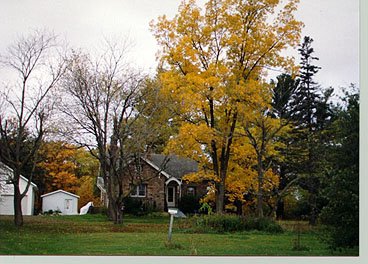
butternut treeYou know how, when you don't know anything about a thing, it seems so esoteric, but once you learn about it, you take it for granted, you feel everybody in the world must know, must always have known it? Is there a name for that?

If there is, and I find it out, I'll feel like I should have known it all along! But meanwhile, I'm giving it my own label: Corbett's Law.

There have only been a couple of times in my life that I have observed something, or figured something out, and it felt like a real discovery, and continued to feel that way. In fact, there's only one observation of that nature I can specifically recall: the leaves of the butternut tree all fall off at the same time.

That seems amazing and unusual to me, and I have never read about it or overheard anybody mentioning it, and so it continues to feel like new knowledge to me. It seems like the kind of event that indigenous people would create a holiday around: the day the butternut leaves fall. Like the day the swallows come back to Capistrano. Perhaps somewhere, at some time, somebody did, but it's lost to history. In the suburban neighborhood where I used to live in Wilbraham, Massachusetts, and which was lined with butternut trees, however, nobody seemed to notice or care. It's a good bet that I was the only person on the street who even knew those trees were butternuts.

They had fruits the size, shape, and color of limes, but hard enough to brain you with. When cars ran them over they left a mess. The rinds or husks or whatever they are on the unripe nuts leave a terrible stain, on your hands or on the asphalt. The shell is tough to crack, and the meat even tougher to get out....impossible to extract in one piece....I can imagine pioneer children spending the whole winter by the firelight working doggedly to pick out the pieces. (Worth it, though. On chocolate cake with chocolate frosting...yummy.)

The leaves of the butternut tree are palmate and turn golden yellow in the fall. One day, the tree is full of leaves and the next it's bare. The ground under the tree will have a wide doughnut of leaves under it, as though the tree had dropped its pants. You go out and rake them all up and that's that. Very neat; perfect for the weekend warrior.

Each tree has its own timer, on the other hand. You'll notice in the picture that one tree is completely full of leaves, while the other two next to it are completely bare. And of course all the maples, oaks and birches aren't nearly as accomodating, so the yard's a mess till spring anyhow.

Unfortunately, in the scheme of things an intimate knowledge of the habits of the butternut isn't a drop in the bucket compared to all the other things you have to keep in your head--and wonder if you should be trying to put into other people's, if you're a teacher or a writer at any rate. I'm presently researching ideas for articles, and it seems that everything's already been said. I just stumbled across the Festa della Donna, an Italian holiday with origins in the Triangle Shirtwaist Fire of 1911 in Manhattan. It seemed so wonderfully obscure to me--yesterday--but suddenly I find myself wondering if it's old hat--to everyone else, at least. Or of no possible interest to anyone except a few weirdos like me. That's Corbett's Law in a nutshell.

Labels: , , ,